How to Build a Lead Generation Funnel That Turns Google Ads Clicks Into Sales
Introduction: The Lead Generation Funnel Framework
Every day, thousands of Singapore businesses spend money on Google Ads, watching their carefully crafted advertisements appear at the top of search results and across the Google Display Network. Yet many face a persistent problem: clicks don’t translate into sales. The traffic arrives, the landing page loads, but then nothing. No conversions. No qualified leads. No revenue growth to justify the advertising spend.
This disconnect reveals a critical gap in how most companies approach digital marketing. They treat Google Ads as a standalone solution—a traffic generation machine that should magically produce sales. But the truth is more nuanced: Google Ads excellence is merely the first step. What happens *after* the click determines whether that paid traffic becomes a valuable customer or wasted spend.
This is where the lead generation funnel changes everything.
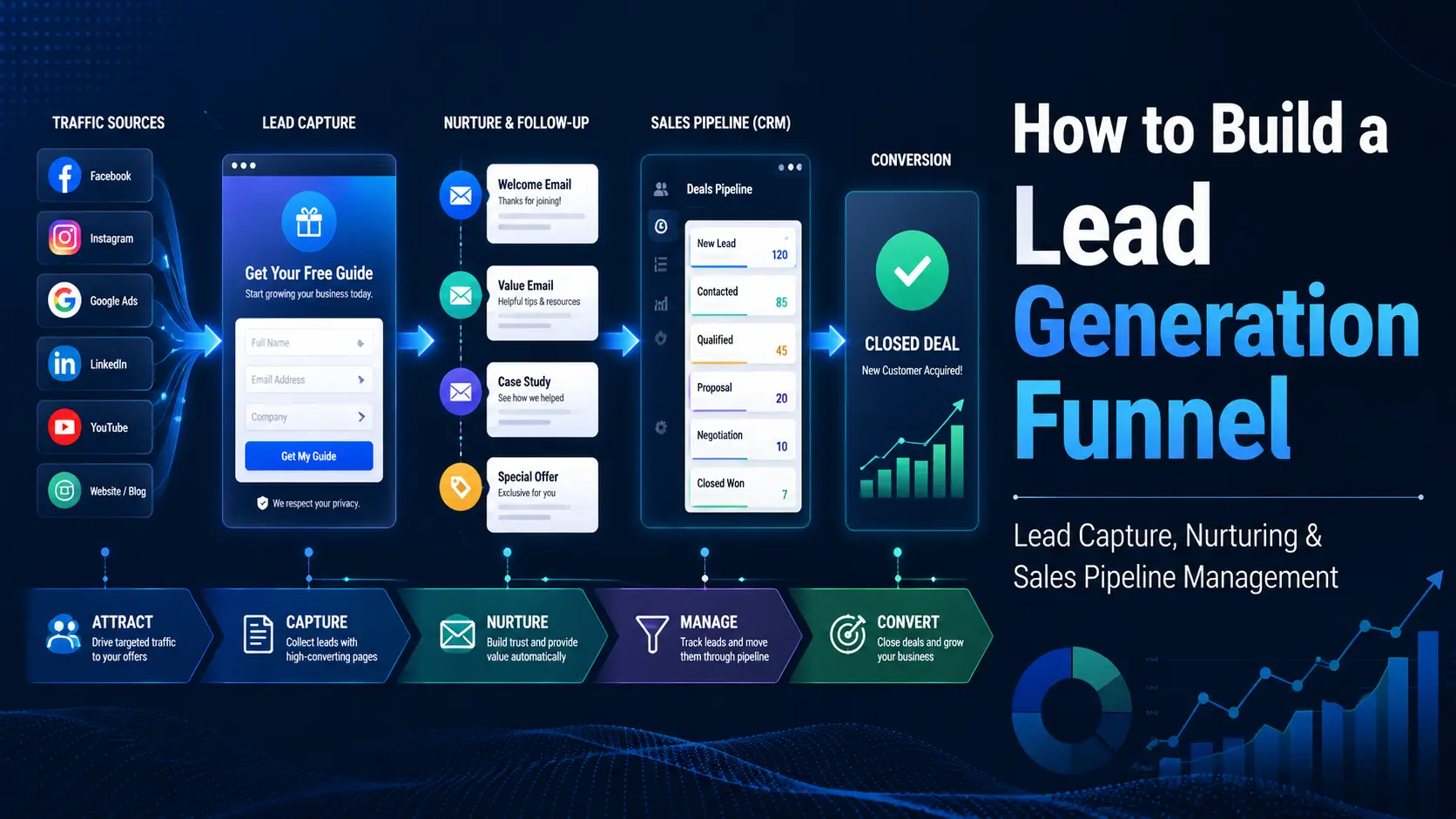
A lead generation funnel is a systematic, structured process that transforms Google Ads clicks into qualified leads, nurtures them through the buyer’s journey, and ultimately passes them to your sales team as legitimate sales opportunities. Unlike transactional sales funnels designed for immediate purchase, a lead generation funnel is built for businesses with longer sales cycles, higher-value decisions, or multi-stakeholder approval processes—which describes much of Singapore’s B2B market, professional services sector, and fintech ecosystem.
According to marketing automation research, businesses with mature lead generation funnels see a 40-60% reduction in customer acquisition costs compared to companies relying on ad traffic alone. For Singapore businesses operating in competitive markets like financial services, enterprise software, consulting, and real estate—where customer acquisition costs can be substantial—this efficiency gain represents millions in potential savings.
The fundamental insight underlying successful lead generation is this: you cannot manage what you do not systematize. By creating a repeatable, measurable framework that moves prospects from initial awareness through to sales-ready qualification, you unlock critical advantages. First, you understand exactly how much you’re spending to acquire each qualified lead, allowing precise ROI calculations. Second, you identify exactly where prospects drop out and systematically improve those weak points. Third, you enable predictable revenue forecasting because your pipeline becomes measurable and consistent. Finally, you create competitive advantage by nurturing leads at scale—something your sales team could never accomplish manually.
This comprehensive guide walks you through building a complete lead generation funnel specifically designed for Google Ads traffic and Singapore market conditions. The framework integrates Google Ads traffic generation, high-converting landing pages, strategic lead magnets, marketing automation, and sales pipeline management into a cohesive system. Most importantly, it’s designed to be measured, tested, and continuously improved—creating a lead generation engine that becomes more efficient the longer you operate it.
—
Understanding the Lead Generation Funnel
What Is a Lead Generation Funnel?
Before implementing, you need a shared understanding of what a lead generation funnel actually is—particularly how it differs from other marketing frameworks.
A lead generation funnel is a multi-stage system designed to attract potential customers, capture their contact information, qualify their sales potential, and systematically nurture them until they’re ready for direct sales engagement. Each stage serves a specific purpose, moving prospects closer to a buying decision while filtering out those who don’t fit your ideal customer profile.
Think of it as a filtering and cultivation process. Wide at the top—attracting many potential prospects through Google Ads and other awareness channels—the funnel narrows progressively as you qualify leads, eliminate poor fits, and concentrate your efforts on the most promising opportunities. Your sales team only engages with prospects who have already demonstrated genuine interest and met basic qualification criteria, dramatically improving sales efficiency.
The core difference between a lead generation funnel and a traditional sales funnel lies in the timeline and engagement model. An ecommerce funnel moves customers from awareness to purchase in days or weeks, often without personal sales interaction. A lead generation funnel assumes a longer sales cycle where prospects need education, relationship-building, and permission-based nurturing before engaging with a salesperson. This distinction is critical for Singapore’s B2B market, where enterprise purchasing decisions often require board approval, stakeholder alignment, and extensive evaluation periods.
The Four Primary Stages
Awareness Stage represents your initial point of contact with prospective customers. Google Ads plays its most obvious role here—creating visibility among your target audience. These prospects may not yet recognize their own need for your solution, or they may be aware of the problem but don’t know solutions exist. Your job at this stage is visibility and education, not hard selling. Google Search Ads targeting problem-related keywords, Display Network ads reaching interested audiences, and YouTube ads providing educational content all function at this awareness level.
Interest Stage occurs when prospects move beyond passive awareness. They’ve clicked your ad, visited your landing page, and demonstrated enough interest to engage further. At this point, they’re considering whether your solution might address their situation. Lead magnets—valuable resources like guides, templates, assessments, or webinar invitations—play their primary role here. By offering genuine value in exchange for contact information, you transform anonymous traffic into named leads you can nurture.
Consideration Stage encompasses the bulk of your nurturing process. Leads now have your contact information and have received your lead magnet. Through email marketing, content marketing, and targeted messaging, you’re positioning your solution within the context of their specific needs. Marketing automation workflows deliver relevant content based on their behaviour, engagement level, and profile fit. You’re building credibility, demonstrating expertise, and helping prospects evaluate their options—hopefully positioning your company favourably.
Conversion Stage is where marketing hands off to sales. Marketing-qualified leads have progressed through nurturing, demonstrated sufficient engagement, and meet your ideal customer profile criteria. At this point, they transition to your sales team as sales-qualified leads. The sales conversation shifts from education and problem awareness to solution evaluation and buying process navigation. This stage includes the actual sales engagement, proposal development, negotiation, and ultimately the decision to become a paying customer.
Critically, a lead generation funnel is not simply these stages in isolation. It’s the systematic integration of all the tools, processes, and platforms that execute each stage: the Google Ads campaigns that drive traffic, the landing pages that capture information, the marketing automation that nurtures automatically, the CRM that tracks the sales process, and the metrics that measure performance. Without this integration, you have disconnected activities rather than a genuine system.
Why Your Business Needs a Dedicated Lead Generation Funnel
Consider the typical scenario for a Singapore B2B company before implementing a systematic funnel. The company invests SGD 5,000–10,000 monthly in Google Ads, generating 500–1,000 clicks. Yet only 5–15 actual sales conversations happen monthly, and maybe 1–2 deals close. Cost per acquisition hovers around SGD 3,000–5,000, leaving little room for error, scaling, or profit.
Now consider the same company with a structured lead generation funnel. The same ad spend generates the same clicks. But through a well-optimized funnel, 50–100 of those clicks convert to leads (5–10% conversion rate instead of 1–2%). Those leads enter an automated nurturing sequence that qualifies and educates them simultaneously. After 30–60 days, 20–40 of these leads are genuinely sales-qualified. The sales team engages with pre-qualified, educated prospects—resulting in 10–15 sales conversations and 3–5 closed deals monthly. Cost per acquisition drops to SGD 1,000–1,500, and your revenue from the same ad spend increases 200–300%.
This pattern repeats consistently across Singapore’s professional services, fintech, B2B SaaS, and consulting sectors. The difference between struggling with ad spend and thriving with it is funnel architecture.
Cost-per-lead efficiency is the most immediate benefit. When you capture and track cost per lead throughout your funnel, you gain visibility into one of your most important metrics. You can see exactly how much you’re spending to acquire each prospect at various stages. This allows ruthless optimization—identifying which traffic sources, campaigns, ad variants, and landing pages deliver leads most cost-effectively. Over time, systematic improvement in cost per lead directly improves profitability.
Conversion rate improvement compounds this benefit. Because you’re nurturing leads systematically through marketing automation, more of them eventually become sales-ready. Your conversion rate from lead to customer improves because prospects are better educated, more qualified, and more convinced of your solution’s value before sales engagement. Additionally, you reduce the time your sales team spends on unqualified prospects.
Sales pipeline predictability represents an often-overlooked advantage. With a structured funnel where you track each stage’s conversion rates, you can forecast future sales with reasonable accuracy. If you know that 50 leads per month enter the funnel, 20 progress to sales-ready status, and 5 close, you’ve created a predictable system. This predictability allows strategic planning, resource allocation, and confident growth forecasting.
Scalability and business growth naturally follow predictability. Once you’ve validated your funnel mechanics and know your conversion rates at each stage, scaling becomes straightforward. Want 2x revenue? Generate 2x leads at the top of the funnel. Because your system is systematized, you can scale confidently without hiring proportionally more salespeople or worrying about execution breakdown.
Marketing and sales alignment improves dramatically. When both teams agree on what constitutes a qualified lead, and when leads enter the sales process already educated about your solution, friction dissolves. Sales stops complaining that marketing sends unqualified leads. Marketing gains credibility because the leads they nurture actually convert. This alignment reduces territorial conflicts and enables both teams to focus on their core competencies.
For Singapore businesses specifically, market dynamics make funnel building particularly urgent. Competition is intense, customer acquisition costs are rising, and differentiation has become difficult. Companies that haven’t systematized their lead generation often find themselves in a race to the bottom on pricing. Companies with mature funnels have acquired customers so efficiently that they can afford to compete on value rather than price, maintain healthy margins, and invest in continuous improvement.
—
Target Audience Identification and Definition
Defining Your Ideal Customer Profile
Before building a single landing page or setting up automation, you must deeply understand who you’re trying to reach. This foundational work determines everything that follows—which keywords you’ll target, which landing page messages will resonate, which lead magnets will attract your best prospects, and which leads your sales team should prioritize.
Your ideal customer profile (ICP) is a detailed description of the company or individual that represents your perfect customer. This isn’t your “target market”—that’s too broad. A Singapore fintech company might have a target market of “SMEs in Southeast Asia,” but their ideal customer profile is far more specific: “Singapore-registered companies with 50–500 employees, annual revenue SGD 5–50 million, in the logistics or e-commerce sectors, that process 100+ daily transactions and currently manage reconciliation manually.”
The difference is critical. Your target market defines who you could potentially sell to. Your ideal customer profile defines who you should focus your marketing and sales efforts on, because these customers will value your solution most highly, have the budget to afford it, and have the highest probability of becoming long-term, profitable customers.
Building your ideal customer profile in the Singapore context requires understanding several dimensions:
Demographic and firmographic criteria establish the basic parameters. For B2B companies, this includes company size (employee count or annual revenue), industry vertical, geographic location within Singapore, and company age/maturity. For B2C companies, demographics might include age range, household income, education level, job title, and family status. These factors often correlate with both ability and willingness to purchase.
Psychographic criteria describe how your ideal customers think, what they value, and what motivates their decisions. A management consulting firm’s ideal customer might be growth-oriented executives who value innovation, are frustrated with outdated processes, and willing to invest in transformation. Understanding these psychological dimensions helps you craft messaging that resonates emotionally, not just rationally.
Behavioural criteria encompass how your ideal customers research solutions, make purchasing decisions, and engage with vendors. Do they research extensively before contacting sales, or prefer direct conversation? Do they rely on peer recommendations, analyst reports, or case studies? How long is their typical purchasing cycle? In Singapore’s business context, relationship and trust play significant roles—many B2B purchases involve extended relationship-building before formal evaluation begins.
Pain points and motivations represent the problem side of the equation. What specific challenges does your ideal customer face? What inefficiencies frustrate them? What goals are they trying to achieve? Understanding these pain points allows you to position your solution as the answer to a specific, deeply-felt problem rather than as a generic product feature.
Creating detailed buyer personas—narrative descriptions of your ideal customers—serves as a practical tool throughout your funnel building. Rather than saying “mid-size Singapore manufacturing companies,” you create “Priya, Operations Director at a 200-person manufacturing firm in Jurong, responsible for supply chain efficiency, frustrated by disconnected inventory systems, keen to impress her MD with cost improvements.” This persona becomes a touchstone—when writing landing page copy, you ask yourself “Would this resonate with Priya?”
Identifying your ideal customer profile requires qualitative and quantitative research. Qualitative methods include interviewing your best existing customers, asking your sales team which prospects they most enjoy working with, and gathering feedback from prospects who chose competitors. Quantitative methods include analyzing your customer database to find commonalities among your most profitable, longest-staying customers, and using tools like LinkedIn Sales Navigator to understand the profile of companies and individuals in your target market.
Segmenting Your Lead Generation Audience
While your ideal customer profile describes one primary customer archetype, most businesses serve multiple legitimate customer segments, each with somewhat different needs, motivations, and purchasing processes. Rather than forcing all these diverse customers through the same funnel, sophisticated lead generation approaches create separate funnels for distinct audience segments.
Consider a Singapore HR software company. Their ideal customers might include mid-market companies (100–500 employees), large enterprises (1,000+), government agencies, and outsourcing companies. While all these organizations need HR solutions, their buying processes, budget constraints, and pain points differ substantially. The mid-market company needs speed and ease of implementation. The large enterprise needs scalability, extensive customization, and vendor stability. The government agency needs security certifications and compliance features. The outsourcing company needs multi-client management capabilities.
If you create a single lead magnet and landing page, you’re forcing a square peg into a round hole. The messaging that resonates with a mid-market CFO might seem irrelevant to an enterprise IT procurement team. By segmenting your audience and creating tailored funnels, you dramatically improve conversion rates and lead quality.
Audience segmentation strategies for lead generation funnels typically include:
By company size, where a software company creates separate campaigns and funnels for SMEs, mid-market, and enterprise. Each segment sees different landing pages, different messaging, different lead magnets, and potentially different sales approaches.
By industry vertical, particularly for horizontal solutions that serve multiple sectors. A business intelligence platform might create separate campaigns for retail, manufacturing, and financial services—with each funnel addressing industry-specific pain points and use cases.
By buying stage or customer lifecycle stage, where companies segment between new customer acquisition and expansion within existing customers. These require completely different funnel approaches, messaging, and metrics.
By geography or region within Singapore and Southeast Asia, where location-specific regulations, languages, or cultural factors matter.
By use case or problem being solved, where customers arrive at your company for different reasons.
By customer profile (B2B, B2C, B2B2C), where fundamentally different business models require different funnels.
The practical benefit of segmentation is quantifiable. Research shows that segmented campaigns generate 14–70% higher conversion rates than non-segmented campaigns. For a company running a standard funnel converting at 2% from click-to-lead, implementing audience segmentation with 3–4 targeted funnels that each convert at 5–7% dramatically improves overall performance.
Segmentation requires infrastructure—your marketing automation platform must track which segment a lead belongs to, route them to segment-specific nurturing sequences, and tag their profile accordingly. Modern platforms like HubSpot, Marketo, and Pardot handle this elegantly. Your CRM must also reflect segmentation so that sales teams understand the context and buying stage of each lead.
The rule for implementing segmentation is simple: if you can identify a segment where customer pain points, buying processes, or messaging needs differ substantially from your primary ideal customer profile, create a separate funnel. Start with your top 2–3 segments rather than overwhelming yourself with 10 different funnels. As you mature, add more segments and continuously refine segment targeting.
For Singapore businesses specifically, valuable segmentation often exists between Singapore-based companies (with clear regulatory environment and established relationships) versus rest-of-Southeast-Asia expansion targets (with different compliance requirements and market dynamics). This segmentation often determines everything from the support team’s focus to how you position your solution’s advantages.
—
Landing Page Design and Optimisation
The landing page represents the critical conversion point between paid advertising and lead capture. It’s where your Google Ads investment converts into measurable business value—or gets wasted. A 1% difference in landing page conversion rate doesn’t sound dramatic, but for a company running 10,000 clicks monthly, the difference between 2% and 3% conversion is 100 additional leads monthly—over 1,200 leads annually. If those leads have a 10% sales conversion rate, that’s 120 additional customers yearly. If the average customer lifetime value is SGD 50,000, you’ve created SGD 6 million in additional revenue through a single percentage-point improvement.
This mathematical reality explains why high-performing companies obsess over landing page optimization. It’s not perfectionism—it’s profit maximization.
Building High-Converting Landing Pages
A high-converting landing page isn’t beautiful or clever or entertaining. It’s specifically engineered to move a particular prospect type through a particular stage of your funnel. Beauty is irrelevant if it obscures the conversion goal. Cleverness is counterproductive if it distracts from the core message.
Instead, high-converting landing pages are built around fundamental principles refined through thousands of tests across multiple industries and markets:
Alignment with advertising message is foundational. When a prospect clicks your Google Ad with headline “Cut Your Invoice Processing Time by 60%” and lands on a page with completely different messaging about vendor management features, friction emerges. The landing page headline should mirror or directly expand on your ad headline, confirming that the prospect has landed in the right place and you understand their specific need.
Clear value proposition communicates why the prospect should care about your offer—specifically *their* offer, not a generic company description. Rather than “We provide cloud-based HR software for mid-market companies,” a high-converting page states “Reduce your HR team’s administrative workload by 40% so they can focus on strategic initiatives.” The value proposition directly addresses a specific benefit the prospect cares about.
Focused message hierarchy guides the prospect through the page in a logical sequence that builds persuasiveness. Landing pages should never try to communicate everything about your company. Instead, they focus on a single core message (often aligned with the ad that drove traffic), with supporting statements that build credibility and urgency. A typical high-performing page flows: compelling headline → relevant subheading → problem-and-solution statement → brief key benefits → social proof/credibility indicators → compelling CTA → lead capture form.
Mobile-first design is non-negotiable in Singapore and throughout Asia, where mobile browsing dominates. Over 70% of internet users in Singapore access content primarily via mobile. Yet many B2B companies still design landing pages optimized for desktop viewing, forgetting that their B2B prospects access content on mobile devices too. High-converting pages work flawlessly on mobile: touch-friendly buttons, readable text without zooming, fast load times, and streamlined design that doesn’t require horizontal scrolling.
Specific, audience-aware copy speaks in the language and concerns of your target audience rather than generic marketing language. Copy written for a CMO at a mid-market retailer addressing their need to reduce inventory costs sounds completely different from copy written for a warehouse manager at a logistics company trying to reduce space requirements. Both might be considering the same solution, but their concerns differ. Audience-aware copy demonstrates deep understanding of their specific situation, building credibility and resonance.
Trust signals and social proof address the implicit skepticism every prospect brings. Effective trust signals for Singapore audiences include local client logos (if recognizable), client testimonials with names and titles, certifications relevant to their industry, media mentions in respected publications, and case studies with specific, verifiable results. A testimonial from “David, Kuala Lumpur” carries less weight than “David Lim, Operations Director, XYZ Manufacturing, Jurong” with measurable results: “Reduced inventory holding costs by 22%, saving SGD 400,000 annually.”
Urgency and scarcity elements motivate action without feeling manipulative. Rather than fake urgency (“Offer expires today!”), authentic urgency for lead generation focuses on the prospect’s situation (“Rising material costs make this optimization more critical now”) or limited resources (“We’re accepting 5 new clients this quarter before pausing intake”).
Lead Capture Forms and Contact Information Collection
The form where prospects enter their contact information represents the moment of friction in your lead generation funnel. They’ve become interested enough to provide their details, but they haven’t crossed the line to active selling yet. They’re still evaluating, still considering, still assessing whether this is worth their time. Your form design either facilitates or impedes this conversion.
Research consistently shows that form field quantity directly impacts completion rates. A form with three fields converts at roughly double the rate of a form with ten fields. Yet most companies don’t create intentionally short forms—they simply try to collect everything they think might be useful. This approach prioritizes information collection over conversion.
A better framework is progressive profiling: collect minimal information on first conversion, then progressively collect additional information as leads engage further. Your initial form on a top-of-funnel landing page might ask for just name, company email, and company name—three essential fields that allow you to identify the prospect and reach them. After they access your lead magnet, they receive email nurturing that includes forms for additional information. By the time they reach sales-ready status, you’ve gradually collected comprehensive qualification information without the early-funnel friction of a 10-field form.
Required versus optional fields represent another design decision. Marking essential fields (name, email, company) as required ensures you collect complete information on primary details. Making nice-to-have fields (phone number, company size) optional balances information collection with conversion rate.
Form validation and user experience matter more than most companies realize. A form that validates fields in real-time, clearly indicates required fields, shows progress on multi-step forms, and prevents errors through good design creates a frictionless experience. Conversely, forms that validate only upon submission, display confusing error messages, or require re-entry of information when errors occur frustrate prospects and increase abandonment.
Multi-step forms versus single-step forms represent an interesting optimization question. Counterintuitively, well-designed two-step or three-step forms sometimes convert at higher rates than single-step forms, even though they require additional clicks. The reason: each step feels less overwhelming. A three-step form showing basic information on step one, company details on step two, and challenge/opportunity on step three feels less daunting than one massive form. However, this only works if each step takes 10–20 seconds and navigation is smooth.
Privacy compliance with Singapore’s PDPA is non-negotiable. The Personal Data Protection Act requires that you obtain explicit consent before collecting personal data, clearly explain how you’ll use the data, and provide clear unsubscribe mechanisms. Your lead capture form should include explicit consent language: “I consent to receive information about [specific topic] from [your company].” This isn’t just compliance—it’s also quality control. Prospects who explicitly opt-in to communication typically have higher engagement rates.
Incentivizing form completion with your lead magnet is essential. Make the value of the lead magnet absolutely clear before the form, so prospects understand exactly what they’ll receive in exchange for their information. A specific CTA like “Download this 30-page guide showing exactly how 50 Singapore companies reduced invoice processing time by 40%+” converts better than a vague “Download our guide.”
The metrics for form performance are straightforward: conversion rate (percentage of page visitors who complete the form), form abandonment rate (percentage who start but don’t finish), and average time-to-completion. Continuous testing of form design—field count, field order, form step structure, validation, button copy—can improve conversion rates 20–40%. For a company receiving 10,000 clicks monthly with a 2% form conversion rate (200 leads), improving to 2.5% conversion represents 50 additional leads monthly, or 600 annually.
This investment in form optimization often yields better ROI than improving ad targeting or increasing ad spend. Yet it’s less glamorous, so it receives less attention. Sophisticated marketers build this optimization into their testing plan from day one.
—
Lead Magnet Strategy and Implementation
The lead magnet represents the value exchange that transforms anonymous website visitor into named lead. You offer something valuable—education, efficiency, clarity—in exchange for contact information. Done right, this creates a win-win: the prospect receives immediate value from your lead magnet, and you receive permission to nurture them toward a buying decision.
Creating Compelling Lead Magnets
A compelling lead magnet succeeds on multiple dimensions simultaneously:
It addresses a specific pain point or need that your ideal customer experiences. Not a generic interest, but a concrete problem they want solved. A generic lead magnet titled “The Complete Guide to Marketing Automation” appeals to nobody specifically. A targeted lead magnet titled “How to Set Up Lead Scoring in HubSpot: A 5-Step Implementation Guide for SGD 100K+ ARR SaaS Companies” appeals directly to high-value B2B software companies trying to implement sophisticated lead qualification.
It provides immediate, standalone value rather than being a thinly-veiled sales pitch. Prospects should feel they’ve received something genuinely useful after accessing your lead magnet, even if they never engage with your company further. This serves two purposes: first, it builds goodwill and credibility, making them more receptive to future nurturing messages. Second, it filters your audience—prospects accessing your lead magnet genuinely found it valuable, indicating qualified interest.
It’s appropriately comprehensive for the funnel stage. Awareness-stage lead magnets (targeting cold traffic that just discovered your company) should be brief, quick to consume, and focused on problem education rather than solution-specific education. A 10-minute checklist works well. Consideration-stage lead magnets (targeting people who know they have a problem and are evaluating solutions) can be longer and more detailed. A comprehensive 30-page guide to implementation best practices works well.
It matches the format your audience prefers consuming. While written guides work well for many audiences, particularly those in technical roles, other audiences prefer video, interactive tools, or assessment-based content. A financial services audience might prefer a downloadable spreadsheet template. A technical audience might prefer sample code or configuration templates. Audience research—asking your sales team what formats prospects prefer, testing different formats with your analytics—informs this decision.
It creates urgency for action. A lead magnet sitting available forever creates no motivation to take action. Consider adding scarcity: “Webinar Recording—Available for 7 Days Only” or “Complimentary 15-Minute Consultation—Limited to 20 Participants” or “Assessment Tool—Free Access Ends 31 March.” This scarcity must be authentic—fake deadlines destroy credibility—but real scarcity motivates action.
It aligns with your overall positioning and solution. Your lead magnet isn’t the place to be clever and bait-and-switch prospects. If you position your solution as “enterprise-grade fraud detection software,” your lead magnet shouldn’t be “Ultimate Guide to Retail Marketing.” That mismatch attracts wrong-fit prospects. Instead, your lead magnet might be “10 Red Flags That Indicate Fraud in Your Payment Processing” or “Compliance Audit Checklist for Payment Processors.” This aligns with your solution while providing genuine value.
For Singapore businesses specifically, effective lead magnet types include:
Downloadable guides and checklists work exceptionally well because they provide concrete, actionable frameworks. A B2B services company might offer “Singapore SME Expansion Checklist: 47 Critical Steps Before Expanding Across Southeast Asia.” A financial services company might offer “Risk Assessment Framework for Trade Finance Operations.”
Webinars and video content appeal to busy professionals who prefer learning through listening. Live webinars create urgency and exclusivity, while recorded webinars offer convenience.
Interactive assessment tools are underutilized but highly effective. An assessment asking 10–15 questions about a prospect’s situation, then providing customized results, creates engagement while teaching the prospect about their situation. An operations efficiency assessment might categorize companies as “Manual Processes,” “Partially Automated,” or “Fully Optimized,” with custom recommendations for each. This serves the prospect while qualifying them for sales.
Templates and frameworks provide immediate utility. A financial modelling template, a project management template, a pricing framework, a sales call script—these let prospects immediately apply your expertise to their situation.
Free tools or software trials work well for software-based solutions. Rather than a guide about your software, offering 30-day free trial access removes the barrier to evaluation.
Case studies and comparison guides appeal to prospects in later buying stages. A case study showing how a similar Singapore company solved their problem provides both inspiration and proof. A comparison guide (“HubSpot vs Marketo vs Pareto vs Salesforce Marketing Cloud: Feature-by-Feature Comparison”) attracts prospects actively evaluating solutions.
Distributing Your Lead Magnet Through Google Ads
A compelling lead magnet provides zero value if nobody accesses it. Google Ads offers multiple formats for promoting lead magnets effectively:
Search Ads targeting bottom-of-funnel keywords like “[industry] + [problem] + solution” drive highly qualified traffic. Someone searching “invoice processing automation Singapore” has explicit intent to solve that problem. Your search ad promoting your lead magnet on that exact topic achieves high click-through rates and form conversion rates. CPL tends to be higher than awareness-stage campaigns but lead quality is exceptional.
Display Ads retarget previous website visitors, promoting your lead magnet to people already familiar with your brand. Display ads to site visitors typically achieve much higher conversion rates than cold display ads because you’re reaching warm audiences. This is particularly effective for mid-funnel prospects who visited your website but didn’t convert on first visit.
Lead Form Ads (available on LinkedIn and some Google Display Network partners) allow prospects to submit contact information directly within the ad, without visiting your landing page. This significantly lowers friction and improves conversion rates. Lead form ads work exceptionally well for B2B lead magnets where you’re promoting something like a webinar registration or assessment tool.
YouTube Ads can promote educational video-based lead magnets. A prospect watching a YouTube video on a problem related to your solution sees your ad offering a deeper educational resource. They click to your landing page, download the guide, and enter your funnel. YouTube ads’ relatively low CPM (cost per thousand impressions) makes them efficient for awareness-stage lead magnet promotion.
—
Lead Capture, Qualification, and Nurturing
Setting Up Marketing Automation for Lead Nurturing
Once a prospect becomes a named lead, your marketing automation system takes over the nurturing process. This systematic, automated approach nurtures leads 24/7 without requiring sales team involvement.
Choosing the right marketing automation platform for Singapore businesses requires assessing your specific needs. For SMEs and early-stage companies, HubSpot’s free tier or affordable starter plan provides solid functionality. For mid-market companies requiring sophisticated segmentation and multi-channel campaigns, HubSpot’s professional tier, Marketo, or Pardot offer more advanced capabilities. For e-commerce businesses prioritising email marketing, Klaviyo excels. For general small business automation, ActiveCampaign provides good value.
Key capabilities your platform should have include:
- Email automation workflows that trigger based on lead behaviour or profile criteria
- Lead scoring that identifies when leads reach sales-ready status
- Segmentation that tags leads and delivers segment-specific content
- Landing page builder for creating segment-specific landing pages
- CRM integration that syncs with your sales system so sales sees all lead activity
- Analytics and reporting that tracks conversion rates through each funnel stage
Structuring your lead nurturing email sequences requires careful planning. A typical mid-funnel nurturing sequence for a B2B software company might look like:
*Email 1 (immediately upon lead capture):* “Welcome + Lead Magnet Delivery + Next Steps”—Confirms their registration, delivers the promised resource, and previews upcoming emails so they understand what to expect.
*Email 2 (24 hours later):* “Deeper Insight into Problem”—Builds on the lead magnet by providing additional context about the problem they’re trying to solve. Shares a customer story or data point illustrating the problem’s business impact.
*Email 3 (3 days later):* “Introduces Your Approach”—Positions your unique perspective or methodology for addressing this problem. Differentiates you from competitors without hard selling.
*Email 4 (5 days later):* “Social Proof and Customer Success”—Shares customer testimonials, case studies, or usage statistics demonstrating that real companies trust you.
*Email 5 (7 days later):* “Objection Addressing”—Anticipates common concerns or objections prospects have, addressing them directly. “Many of our customers initially worried about implementation time…”
*Email 6 (10 days later):* “Next Steps / Sales Conversation Offer”—Invites them to a discovery call, demo, or next step in the evaluation process. Removes friction with clear instructions on how to proceed.
This sequence takes 10 days and delivers 6 carefully-sequenced touchpoints. Each email builds on the previous one, progressively moving the prospect closer to sales-ready status. The sequence can repeat or adapt based on prospect engagement—prospects who click and read every email move to the next stage faster, while those showing lower engagement might receive a re-engagement sequence.
Personalisation and dynamic content beyond basic name insertion significantly improves engagement. Rather than “Hi [First Name],” use conditional logic to personalise:
- If company size is “enterprise,” emphasize scalability and support
- If company size is “SME,” emphasize ease of implementation and affordability
- If prospect is in financial services, reference industry compliance concerns
- If prospect is in retail, reference seasonal demand considerations
- If prospect clicked certain links, reference their specific area of interest
This level of personalisation requires sophisticated automation platform capabilities, but substantially improves email engagement and conversion rates.
Lead Scoring and Sales Readiness
Not all leads are sales-ready at the same time. Some will be ready for sales engagement after two weeks; others might need two months of nurturing. Your lead scoring system identifies which leads are sales-ready so your sales team can focus on the highest-probability opportunities.
Implementing lead scoring in Singapore context requires balancing demographic fit and behavioural engagement:
Demographic Scoring assesses whether the lead matches your ideal customer profile:
- Company size (ideal range gets full points, outside range loses points)
- Industry (target industries get full points, non-target get zero points)
- Geographic location (Singapore gets points; overseas varies)
- Seniority level (decision-makers get higher scores