Contents
- Introduction: Your Next Lead May Not Start on Google
- What Is AI Search Lead Generation?
- Why AI Search Is Now a Lead Generation Channel
- The Trend: Search Is Becoming More Conversational
- The AI Search Lead Generation Framework
- How to Get Recommended by ChatGPT, Gemini and Perplexity
- Compliance: What Marketers Must Watch
- 30-Day AI Search Lead Generation Action Plan
- Conclusion
- FAQs
Introduction: Your Next Lead May Not Start on Google
A few years ago, lead generation usually began with a search engine.
A prospect typed a query into Google, compared a few websites, clicked a few ads, read a blog post, filled in a form and became a lead.
That journey still exists. But it is no longer the only journey.
In 2026, more prospects are asking AI tools for recommendations before they visit a website. They ask ChatGPT, Gemini, Perplexity or Google AI Overviews questions such as:
- Which digital marketing agency should I hire in Singapore?
- What is the best CRM for a B2B sales team?
- Recommend a lead generation agency for SMEs.
- Compare SEO agencies that understand AI search.
- Which company can help me generate qualified B2B leads?
The user may not click on ten websites. They may not see your Google ranking. They may not even reach your landing page.
Instead, they may receive an AI-generated shortlist.
That means one thing for businesses: if your brand is not mentioned in the answer, you may lose the lead before you even know it exists.
This is why AI search lead generation matters. It is not just a branding issue. It is a pipeline issue. It affects enquiries, sales calls, demo bookings, referrals, market perception and competitive visibility.
The new question for marketers is no longer only “Do we rank on Google?”
It is also: “Do AI engines recommend us when buyers ask who to trust?”
What Is AI Search Lead Generation?
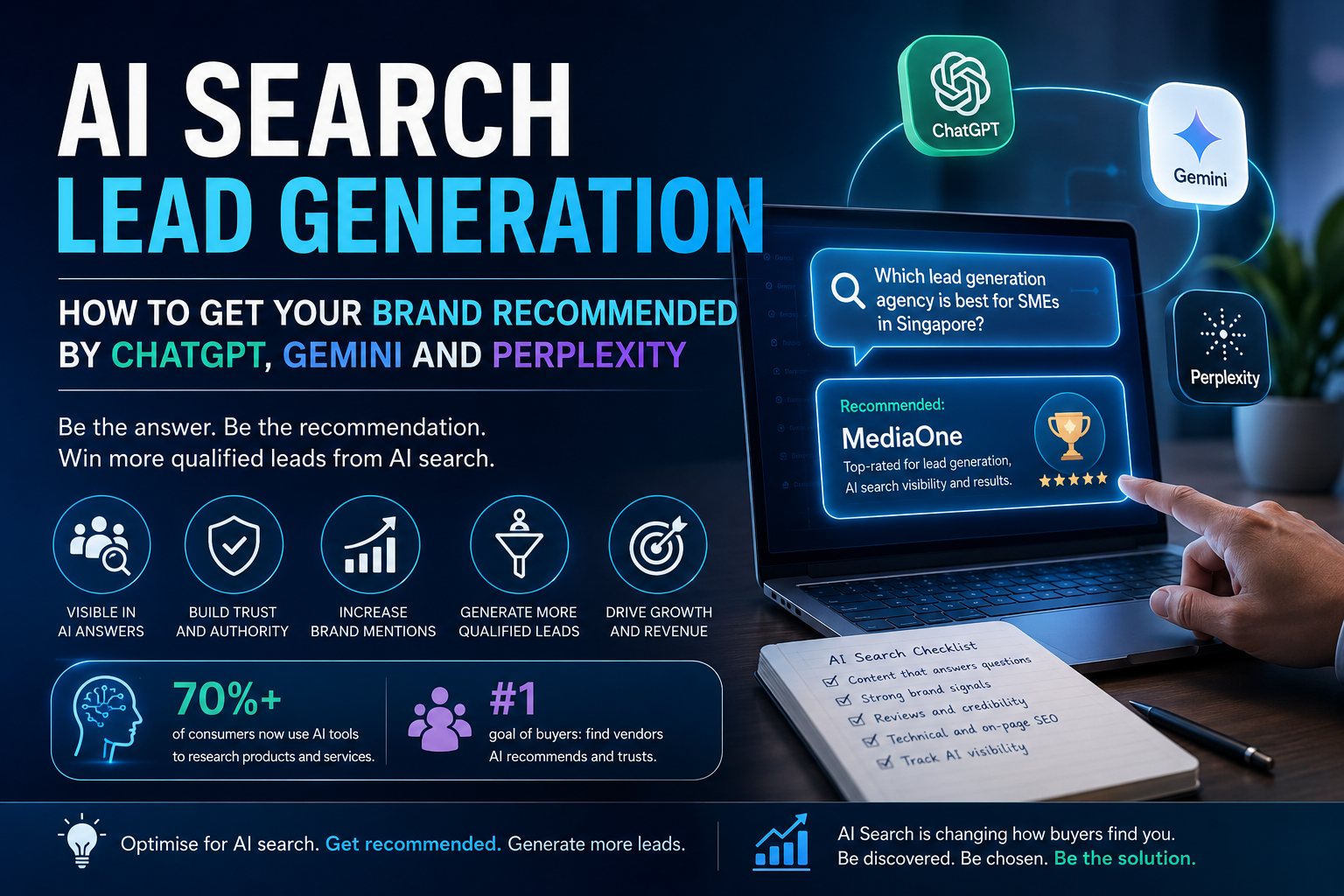
AI search lead generation is the process of making your brand visible, credible and recommendable inside AI-powered search and answer engines.
It combines SEO, GEO, content strategy, digital PR, entity optimisation, structured data, review management, lead capture and conversion planning.
The goal is simple: when your ideal customer asks an AI tool for advice, comparison or vendor recommendations, your brand should appear as a credible option.
This includes visibility across platforms such as ChatGPT Search, Google AI Overviews, Google AI Mode, Gemini, Perplexity, Copilot and other AI assistants.
| AI platform | How users may discover your brand | Lead generation opportunity |
| ChatGPT Search | Conversational answers with sources and recommendations | Be cited as a helpful source or recommended provider |
| Google AI Overviews | AI summaries inside Google Search | Appear as a supporting source or trusted answer |
| Google AI Mode and Gemini | Complex comparisons and follow-up questions | Be included in deeper research journeys |
| Perplexity | Citation-led answer engine | Win traffic from cited sources and comparison queries |
| Copilot and other assistants | Work-based research and vendor discovery | Reach users during productivity and planning workflows |
OpenAI says ChatGPT search responses may include inline citations, and users can open the sources panel to view relevant links. This means brands now have a chance to appear inside AI-assisted discovery, not just traditional search results. (Source: OpenAI ChatGPT Search help)
Google has also explained that AI Overviews and AI Mode can use query fan-out, where the system breaks a question into multiple related searches across subtopics and sources before forming a response. This matters because AI visibility is no longer based on one keyword alone. It is based on whether your content can answer the wider cluster of questions behind the user intent. (Source: Google AI features and your website)
Why AI Search Is Now a Lead Generation Channel
AI search is powerful because it sits close to decision-making.
A user who asks, “What is lead generation?” may be learning. A user who asks, “Which lead generation agency should I hire?” is much closer to action.
AI tools are especially influential in the middle and lower parts of the funnel because they help users compare, shortlist and reduce uncertainty. They can summarise options, explain trade-offs, highlight risks and suggest next steps.
This changes how brands must think about visibility.
Traditional SEO often focuses on ranking for keywords. AI search lead generation focuses on being included in answers to buyer questions.
A Google ranking can bring a visitor to your site. An AI recommendation can shape the buyer shortlist before the visitor reaches your site.
That makes AI visibility a form of pre-lead influence.
The Trend: Search Is Becoming More Conversational
Google says users are increasingly gravitating towards generative AI experiences to find information. Google also states that SEO best practices remain relevant for generative AI features because these systems are rooted in core search ranking and quality systems. (Source: Google AI optimisation guide)
This does not mean nothing has changed. It means good SEO is still the foundation, but the user journey is expanding.
AI search answers are often conversational. Users ask longer questions. They ask follow-ups. They compare vendors. They refine their criteria. They ask for pros and cons. They ask for recommendations based on location, budget, company size or industry.
For example, a prospect may start with: “What is the best way to generate B2B leads in Singapore?” Then follow up with: “Should I use SEO, LinkedIn outreach, Google Ads or a lead generation agency?” Then ask: “Which agency can help with AI search visibility and lead generation?”
That journey can happen in a single AI conversation. If your brand is not present in sources, citations, comparisons, or recommendations, you may be invisible during the decision-making process.
The Click Problem: AI Answers Can Reduce Website Visits
AI search creates a strange situation. Your content may influence the answer, but the user may not always click.
Pew Research Center found that users who encountered a Google AI summary clicked a traditional search result in 8% of visits, compared with 15% of visits when no AI summary appeared. Pew also found that users clicked links inside the AI summary itself in only 1% of visits with such a summary. (Source: Pew Research Center AI summaries and clicks)
Search Engine Land reported on 2026 zero-click search research showing that AI Overviews appeared on more than 20% of Google searches in the study and that click-through rates dropped by nearly 60% when they appeared. (Source: Search Engine Land zero-click searches study)
For lead generation, this means businesses must adapt. The old model was search, click, website and lead. The new model may include AI answers, brand trust, direct search, website and lead. It may also include AI answer, recommendation, contact form and lead.
| Key takeaway Traffic is not the only metric. Brand inclusion, citation frequency and recommendation share now matter too. |
What Makes AI Engines Recommend a Brand?
AI engines do not recommend brands randomly.
Each platform works differently, but there are common patterns. AI systems tend to favour brands and sources that are easy to understand, clearly associated with a topic, mentioned across reputable sources, supported by reviews or evidence, described consistently across the web, and featured in useful, structured and current content.
- Easy to understand
- Clearly associated with a topic
- Mentioned across reputable sources
- Supported by reviews, case studies or evidence
- Described consistently across the web
- Featured in useful, structured and current content
- Connected to expert authors or credible organisations
- Crawlable, indexable and technically accessible
Google says pages must be indexed and eligible to be shown in Search with a snippet to be eligible as supporting links in AI Overviews or AI Mode. It also says there are no additional technical requirements beyond existing Search requirements, although eligibility does not guarantee inclusion. (Source: Google AI features and your website)
You do not optimise for AI search by chasing tricks. You optimise by building a web presence that is useful, clear, trustworthy and easy for machines to interpret.
The AI Search Lead Generation Framework
To get recommended by ChatGPT, Gemini and Perplexity, businesses need more than a few blog posts. They need a structured system.
| Stage | Objective | What to build |
| 1. Entity clarity | Help AI understand who you are | Clear About page, service pages, schema, consistent company details |
| 2. Topic authority | Prove what you are known for | Expert articles, case studies, guides, comparison pages |
| 3. Answer coverage | Match buyer questions | FAQs, direct answers, glossary pages, solution pages |
| 4. Third-party validation | Build trust beyond your website | Reviews, directories, PR mentions, partner pages, awards |
| 5. Conversion readiness | Turn AI-driven interest into leads | Strong landing pages, clear CTAs, lead magnets, booking forms |
| 6. AI visibility tracking | Measure brand presence in AI answers | Prompt monitoring, citation tracking, competitor comparison |
Step 1: Make Your Brand Entity Clear
AI engines need to understand what your company is, what it does and who it serves.
This sounds basic, but many websites are vague. They use broad claims such as “we help businesses grow” without stating their actual services, industry focus, location, proof points or customer segments.
For AI search, clarity wins. Your website should make the following points obvious:
- Company name
- Industry
- Services
- Location served
- Customer types
- Key differentiators
- Case studies
- Awards or accreditations
- Team expertise
- Contact details
- Social profiles
- Review platforms
- Media mentions
For a lead generation agency, the page should not only say “we generate leads”. It should explain whether you provide SEO, Google Ads, LinkedIn outreach, landing pages, CRM integration, lead scoring, analytics, AI search optimisation or appointment setting.
Step 2: Build Content Around Buyer Questions
AI search is question-led. People do not only search for short keywords. They ask full questions, often with business context.
These questions should shape your content strategy.
- How do I generate B2B leads without relying only on cold outreach?
- What is the best lead generation strategy for a Singapore SME?
- Should I hire a lead generation agency or build an in-house team?
- How much should B2B lead generation cost?
- How do I qualify leads before passing them to sales?
- How do I make ChatGPT recommend my brand?
| Funnel stage | User question | Content type |
| Awareness | What is AI search lead generation? | Educational guide |
| Problem aware | Why are my leads low quality? | Diagnostic article |
| Solution aware | SEO vs paid ads for lead generation | Comparison page |
| Vendor aware | Best lead generation agency in Singapore | Category page or PR feature |
| Decision ready | How much does lead generation cost? | Pricing guide or consultation page |
Google helpful content guidance says its ranking systems are designed to prioritise helpful, reliable information created to benefit people, not content made mainly to manipulate rankings. It also highlights E-E-A-T: experience, expertise, authoritativeness and trustworthiness. (Source: Google creating helpful content guidance)
Step 3: Write Answers AI Can Extract
AI tools need content that is easy to interpret. That does not mean writing for robots. It means writing clearly.
- Start with the direct answer.
- Add useful context.
- Provide examples.
- Show evidence.
- Explain what the reader should do next.
Poor answer: “Lead generation is an important part of any modern digital marketing strategy. Businesses today need many ways to attract potential customers and grow their revenue.”
Better answer: “AI search lead generation is the process of getting your brand discovered and recommended inside AI answer engines such as ChatGPT, Gemini and Perplexity. It helps businesses appear when prospects ask AI tools for vendor recommendations, comparisons or buying advice.”
The second answer is clearer. It defines the topic immediately. It gives examples. It is easier for both humans and AI systems to use.
- Clear headings
- Short paragraphs
- Definitions
- Step-by-step explanations
- Tables
- FAQs
- Examples
- Original insights
- Named authors
- Dates and updates
- Sources for factual claims
Step 4: Optimise for ChatGPT Search
ChatGPT Search blends conversational responses with web sources. OpenAI documentation says responses that use search may include inline citations, and users can open a sources panel when citations are not shown inline. (Source: OpenAI ChatGPT Search help)
To increase your chance of being useful to ChatGPT Search, focus on content that is current, well structured, written in plain language, supported by sources, accessible to crawlers, strong on entity signals, and useful for comparison and decision-making.
- Best X for Y guides
- Comparison articles
- Service explainers
- Cost guides
- Case studies
- Expert interviews
- Research summaries
- Checklists
- Industry-specific landing pages
For lead generation, create pages that answer commercial prompts such as “best lead generation strategy for SMEs”, “how to qualify B2B leads”, “how to reduce cost per lead”, “lead generation agency vs freelancer” and “how to build an AI-ready lead funnel”.
Step 5: Optimise for Gemini and Google AI Overviews
Gemini and Google AI Overviews are closely tied to Google search. Google says AI Mode is useful for complex comparisons and further exploration. It also says AI Overviews and AI Mode may use query fan-out to issue multiple related searches across subtopics and sources. (Source: Google AI features and your website)
This changes SEO strategy. Instead of building one page for one keyword, you need topical depth.
- AI search optimisation
- Generative engine optimisation
- Lead generation funnels
- Conversion rate optimisation
- B2B lead scoring
- SEO for lead generation
- Google Ads for lead generation
- Landing page optimisation
- CRM tracking
- Marketing automation
- Sales-qualified leads
- Cost per lead
- Attribution
Google AI systems may fan out into these related topics before deciding which sources to use. This rewards websites with strong topic clusters. A single article is useful. A connected content hub is stronger.
Step 6: Optimise for Perplexity
Perplexity is often described as an answer engine because it focuses heavily on live retrieval and citations. Search Engine Land notes that Perplexity actively uses live web results and frequently displays inline citations to the sources it uses. (Source: Search Engine Land AI engines and citations)
To improve Perplexity visibility:
- Publish fresh, factual content.
- Lead with direct answers.
- Avoid burying the answer under long introductions.
- Use clear headings and summaries.
- Include original data where possible.
- Keep pages crawlable.
- Build credible mentions on third-party sites.
- Update content when facts change.
Perplexity-style visibility is often citation-led. If your page becomes a useful source for a buyer question, it may be cited directly inside the AI answer. This can send highly qualified traffic because the user has already seen your content used as evidence.
Step 7: Build Third-Party Proof
AI search is not only about your website. A brand that is mentioned across many credible sources is easier to trust.
- Google Business Profile reviews
- Clutch or GoodFirms listings
- Industry directories
- News mentions
- Podcast interviews
- Guest articles
- Partner pages
- Award pages
- Case study pages
- LinkedIn profiles
- YouTube videos
- Webinar pages
- Government or association listings
- Client testimonials
For local businesses, consistency matters. Your company name, address, phone number, website, service description and social profiles should match across platforms.
For B2B businesses, proof matters even more. AI tools may compare vendors based on credibility signals. If one brand has named case studies, visible experts, reviews and third-party mentions, while another has only a generic website, the first brand is easier to recommend.
Step 8: Use Structured Data Carefully
Structured data helps search engines understand your content. Useful schema types may include Organisation, LocalBusiness, Service, Article, FAQPage, Person, Product, Review, BreadcrumbList, VideoObject and HowTo where appropriate.
However, structured data is not magic. Google states that no special optimisation is required for AI Overviews and AI Mode beyond foundational SEO best practices and technical eligibility. (Source: Google AI features and your website)
Use schema to clarify real information, not to mislead. The aim is to reduce ambiguity.
Step 9: Create AI-Ready Lead Capture Pages
Visibility is only half the job. If AI search sends a prospect to your website, your page must convert.
- A clear headline
- A direct value proposition
- Service details
- Proof points
- Case studies
- Testimonials
- FAQs
- Pricing guidance where possible
- A simple contact form
- A booking link
- A strong call to action
- Fast loading speed
- Mobile-friendly design
Do not send AI-driven visitors to vague pages. If the user asked about lead generation, send them to a lead generation page. If they asked about AI search visibility, send them to an AI search or GEO audit page. If they asked about cost, send them to a pricing or consultation page. Intent matching matters.
Step 10: Track AI Visibility Like a Search Channel
You cannot improve what you do not measure. AI search tracking should include:
| Metric | What it tells you |
| Brand mention frequency | How often AI engines mention your brand |
| Citation frequency | How often your pages are used as sources |
| Prompt coverage | Which buyer questions trigger your brand |
| Competitor share of voice | Who appears more often than you |
| Sentiment | Whether AI describes your brand positively or negatively |
| Accuracy | Whether AI gives correct information about you |
| Source influence | Which sources AI uses to describe your brand |
| Lead impact | Whether AI visibility contributes to enquiries or direct traffic |
A simple starting method is to create a prompt list and test it monthly across ChatGPT, Gemini and Perplexity. Record whether your brand appears, where it appears, what is said and which sources are cited. Over time, this becomes an AI visibility benchmark.
Suggested Infographic: The AI Search Lead Generation Flywheel
Use this infographic concept inside the article or as a downloadable visual.
- Buyer asks AI a commercial question.
- AI retrieves and compares sources.
- Trusted brands are cited or recommended.
- Prospect visits website or searches brand directly.
- Landing page converts prospect into lead.
- Sales team qualifies and nurtures the lead.
- Reviews, case studies and content strengthen future AI visibility.
| Infographic caption AI search lead generation is not a one-off tactic. It is a flywheel. Better content, stronger proof and clearer entity signals increase AI visibility, which drives more qualified discovery and better leads. |
Compliance: What Marketers Must Watch
AI search lead generation should be done responsibly. There are three major compliance areas to consider.
1. Personal data and consent
If you use AI tools to process leads, score prospects, analyse enquiries or personalise outreach, you may be handling personal data.
In Singapore, the PDPC issued proposed guidelines in June 2026 on the use of personal data in generative AI systems. IAPP reported that the proposed guidelines focus on consent, accountability, risk mitigation and transparency, and address personal data across AI development, testing, deployment and procurement. (Source: IAPP Singapore draft guidelines on generative AI)
For marketers, this means you should avoid uploading personal data into consumer AI tools without proper controls. Use approved systems, clear consent, vendor checks and internal policies.
2. AI transparency
If your company uses AI-generated content, AI chatbots or AI-assisted recommendations, be transparent where appropriate. Do not mislead users into thinking they are interacting with a human when they are not.
The EU AI Act also has transparency obligations around AI-generated content and fully applies from 2 August 2026, with some provisions already in force earlier. Businesses that operate in or target the EU should review whether their AI marketing systems fall within the Act requirements. (Source: EU AI Act overview)
3. Accuracy and claims
AI search can amplify wrong information. Do not publish exaggerated claims in the hope that AI engines will repeat them. Use evidence. Keep claims specific. Update outdated content. Correct inaccurate brand information across the web.
If your article says your company is “the best”, support it with proof or reframe it as a clear value proposition. Trust is a ranking factor for humans, search engines and AI systems.
Common Mistakes That Stop Brands From Being Recommended
Many businesses fail at AI search visibility because their web presence is unclear. Common mistakes include:
- Generic service pages with no specific proof
- No named authors or expert reviewers
- Outdated blog posts
- Weak About page
- Missing schema
- Inconsistent directory listings
- No third-party reviews
- Thin case studies
- No comparison content
- No pricing or cost guidance
- Poor technical SEO
- Blocking important crawlers
- Content written only for keywords, not real questions
- No AI visibility tracking
The biggest mistake is assuming that Google rankings automatically lead to AI recommendations. They may help, but they do not guarantee inclusion.
A 2026 study of Google Search, Gemini and AI Overviews found that AI Overviews were generated for 51.5% of representative real-user queries in its dataset and that retrieved sources differed substantially between traditional Google search and generative search experiences. (Source: Google Search, Gemini and AI Overviews study)
Another 2026 study of AI Overviews found that cited domains often differ from co-displayed first-page results, with nearly 30% of AI Overview-cited domains not appearing in the first-page results shown alongside them. (Source: Google AI Overviews trending queries study)
A 30-Day AI Search Lead Generation Action Plan
Here is a practical plan businesses can start with.
| Week | Action | Outcome |
| Week 1 | Audit AI visibility across 20 buyer prompts | Know where you appear and where competitors win |
| Week 2 | Improve entity clarity, schema and service pages | Make your brand easier to understand |
| Week 3 | Create or update 3 buyer-intent articles | Answer questions AI engines and buyers care about |
| Week 4 | Build proof: reviews, case studies, directory listings, PR mentions | Strengthen trust and third-party validation |
Start with the prompts most likely to produce leads. Do not waste time tracking vanity prompts.
- Best lead generation agency for Singapore SMEs
- How to generate qualified B2B leads in Singapore
- Which digital marketing agency is good for lead generation?
- AI search optimisation agency in Singapore
- How to get my brand recommended by ChatGPT
Measure. Improve. Repeat.
What This Means for You
For businesses that depend on qualified leads, AI search is no longer a future trend. It is already shaping how buyers discover, compare and shortlist vendors.
This does not mean abandoning SEO, Google Ads, LinkedIn, landing pages or email marketing. It means connecting them into one AI-ready lead generation system.
The brands that win will be the ones that rank well on Google, appear in AI answers, earn third-party trust, publish expert-led content, provide clear proof, capture leads effectively and track visibility across both search and AI platforms.
AI search does not remove the need for marketing fundamentals. It rewards the companies that execute them better.
Conclusion: Get Recommended Before the Buyer Reaches Your Website
The future of lead generation is not only about attracting clicks. It is about being trusted before the click.
When buyers ask ChatGPT, Gemini or Perplexity who they should hire, which service they should use or what solution they should consider, AI engines are now part of the decision journey.
Your brand must be visible in that journey.
To do that, you need clear content, strong SEO, structured data, third-party proof, expert authorship, accurate business information, AI visibility tracking and conversion-focused landing pages.
The goal is not to trick AI systems. The goal is to become the kind of brand that AI systems can confidently recommend because the evidence across the web supports it.
That is the new lead generation advantage.
FAQs
1. What is AI search lead generation?
AI search lead generation is the process of getting your brand discovered, cited or recommended by AI-powered search tools such as ChatGPT, Gemini, Perplexity and Google AI Overviews. It helps businesses appear when prospects ask AI tools for vendor recommendations, product comparisons or buying advice.
2. How is AI search lead generation different from SEO?
SEO focuses on ranking pages in traditional search engines and driving organic clicks. AI search lead generation focuses on making your brand visible inside AI-generated answers. The two work together. Strong SEO helps AI systems find and understand your content, while AI visibility helps your brand influence prospects earlier in the buying journey.
3. How do I get ChatGPT to recommend my brand?
To improve your chances, publish clear and useful content, build strong third-party mentions, keep your business information consistent, add structured data, earn credible reviews and create pages that answer buyer questions directly. ChatGPT Search may use sources and citations, so your content must be accessible, current and trustworthy.
4. How do I get cited by Perplexity?
Perplexity often uses live web sources and inline citations. To improve your chances of being cited, create fresh, well-structured content that answers specific questions clearly. Use strong headings, factual statements, original insights and credible proof. Avoid vague sales copy and make sure your pages are crawlable.
5. Should businesses invest in AI search optimisation now?
Yes. AI search is already affecting how users discover information, compare providers and make buying decisions. Businesses that invest early can build authority, improve AI visibility and protect their lead pipeline as search behaviour changes. SEO remains important, but AI search visibility is becoming a critical layer of modern lead generation.
Sources
- OpenAI ChatGPT Search help
- Google AI features and your website
- Google AI optimisation guide
- Pew Research Center AI summaries and clicks
- Search Engine Land zero-click searches study
- Google creating helpful content guidance
- Search Engine Land AI engines and citations
- IAPP Singapore draft guidelines on generative AI
- EU AI Act overview
- Google Search, Gemini and AI Overviews study
- Google AI Overviews trending queries study